
Home »
News · Product
Fridge and Freezer Temperature Monitoring
Wireless fridge and freezer temperature monitoring for food, pharmacy, healthcare and laboratories, from chilled food to −80 °C ultra low freezers, with 24/7 alarms and UKAS calibration.

A fridge or freezer can fail overnight, at the weekend or when a door is left open, and a manual check twice a day will not catch it in time. Wireless fridge and freezer temperature monitoring records every unit around the clock and alerts the right person the moment a temperature goes out of range, so stock is protected and every reading is on record for your next audit.
Why fridge and freezer temperatures need continuous monitoring
Whether you store food, vaccines, medicines or laboratory samples, the rules are the same: keep products within their safe temperature range and be able to prove you did. Paper logs only show a snapshot. A fridge that warms up for six hours overnight and recovers by the morning check leaves no trace on a paper record, but the stock inside may already be unsafe.
Continuous monitoring closes that gap. Wireless sensors record every few minutes, every reading is stored, and alarms are raised as soon as a unit drifts out of range. You can act before stock is lost, and you have a complete digital history to show auditors and inspectors.
What a fridge and freezer monitoring system includes
Our wireless temperature monitoring system is built around the D3 base station and battery powered wireless sensors. A typical system includes:
- Wireless temperature sensors in each fridge, freezer, cold room or display cabinet
- A D3 base station that stores your data securely on site
- Email alerts as standard, plus SMS, voice and app alerts with escalation through MyDataPortal
- Door contact sensors to show when doors are left open
- Audit ready reports and a full history of every reading, alarm and corrective action
- Optional MyDataPortal cloud access, so you can see every site from one dashboard
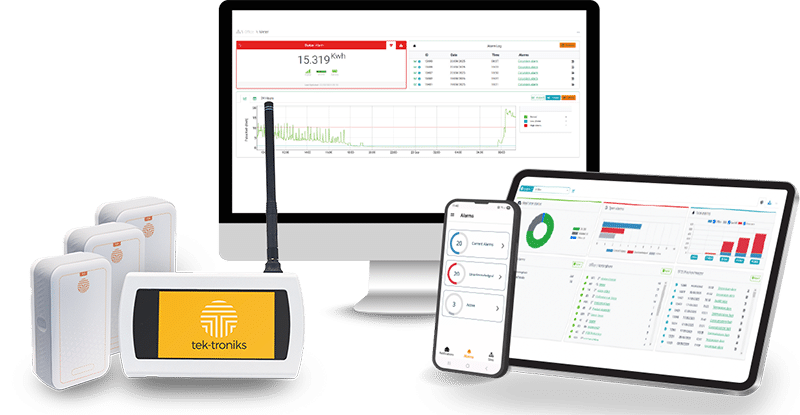
Our sensors use a dedicated, secure 868 MHz wireless network, kept separate from your WiFi, and have a battery life of up to seven years. Sensors fit straight into existing units, so there is no need to replace fridges or freezers that are working well.
Fridge and freezer monitoring by sector
Food production, retail and hospitality
Chilled food is commonly held at 5 °C or below and frozen food at −18 °C or below. Restaurants, cafés, butchers, supermarkets and food manufacturers use our system to monitor fridges, freezers, walk in cold rooms, display cabinets and blast chillers, with automatic records for HACCP, BRCGS and SALSA. See temperature monitoring for the food industry.
Pharmacies, GP surgeries and clinics
Vaccines and most refrigerated medicines must be stored between 2 °C and 8 °C. Continuous monitoring shows every vaccine and medicine fridge has stayed in range, records any excursion with its duration, and gives you the evidence inspectors and your governance teams expect. See medical and laboratory temperature monitoring.
Laboratories and ultra low freezers
Laboratory fridges, freezers and ultra low temperature freezers hold samples and reagents that may be impossible to replace. Our sensors cover everything from standard lab fridges to ultra low freezers at −80 °C and below, with alarms that reach someone even out of hours. See how we monitor fridges, incubators and water baths in our NMR Group laboratory case study.
| Unit | Typical range |
|---|---|
| Food fridge | 5 °C or below |
| Food freezer | −18 °C or below |
| Vaccine and medicine fridge | 2 °C to 8 °C |
| Laboratory freezer | −20 °C to −80 °C for ultra low freezers |
Getting accurate readings from every unit
A monitoring system is only as good as the readings it records. Three things make the difference:
- Probe type. Air sensors react quickly to door openings, which can trigger alarms that do not reflect product temperature. Food simulation probes behave like the product itself, giving truer readings and fewer false alarms.
- Probe position. Temperatures vary inside every fridge and cold room. UKAS accredited temperature mapping shows where the warm and cold spots are, so your monitoring sensors go where they matter most.
- Calibration. UKAS accredited calibration proves each sensor reads correctly. Fixed probes can be calibrated in place, from −80 °C to +55 °C, so your monitoring keeps running.
Alarms that reach the right person
Every sensor can have its own alarm limits and delays, so a door opening during a delivery does not raise a false alarm, but a unit that keeps warming up does. With MyDataPortal, if the first person does not respond, the alarm escalates to the next person on your list by call, text or app notification. Alarms can be paused during cleaning or maintenance, and every alarm and response is recorded in your audit trail.
For regulated sites, we also provide a validated installation with IQ, OQ and PQ documentation, so you can prove the system was installed correctly and works as intended.
Fridge and freezer temperature monitoring FAQs
What temperature should a fridge and freezer be?
Food fridges are commonly kept at 5 °C or below and food freezers at −18 °C or below. Vaccine and medicine fridges must stay between 2 °C and 8 °C. Laboratory freezers vary, from −20 °C to −80 °C for ultra low freezers.
Can I monitor ultra low −80 °C freezers?
Yes. Our sensors cover ultra low temperature freezers at −80 °C and below, and we can calibrate fixed probes in place down to −80 °C under our UKAS accreditation.
Do I need to replace my existing fridges or freezers?
No. Wireless sensors fit into modern and older units without rewiring, so you can monitor the equipment you already have.
How will I know if a fridge fails overnight?
The system alerts you as soon as a temperature goes out of range, by email as standard, or by SMS, voice call and app notification with MyDataPortal. If nobody responds, the alarm escalates to the next person on your list.
Is there a monthly subscription?
No. The D3 system stores your data on site with no licence or subscription fees. MyDataPortal cloud access is an optional paid service.
What we do
Your trusted partner for temperature monitoring and validation services for the food, pharmaceutical, laboratory, logistics and warehousing sectors.
Not sure what you need? Talk to our team for clear, practical advice.
Keep reading
Related articles and case studies
-
Summer and Winter Temperature Mapping
Temperatures inside a warehouse, cold store or storage area change with the weather outside. A space that holds…
-
Warehouse Temperature Mapping
Temperatures in a warehouse can vary widely across the length, height and width of the racking. Warehouse temperature…
-
Food Simulation Probe
The P3-DS326 food simulation probe reads product temperature, not air, for fridges, display cabinets, cold rooms and blood bank fridges, with far fewer false alarms.

